
Walk Santa Monica Streets Parcel by Parcel
A useful Santa Monica street directory starts with one known address and moves in a fixed order. Normalize the number, direction, street name, unit, and ZIP. Locate the parcel in a county or city map, then record the AIN and legal description before looking for a person. The assessor can provide an owner lead for a specific parcel, while the recorder uses that owner's name and an approximate recording year. Historical directories and census schedules then add the occupant layer. The order matters because the Los Angeles County recorder does not offer a public street-address index.
- Enter the address in the Los Angeles County Assessor Map or city parcel tool and verify the parcel shape.
- Write down the AIN, situs, legal description, tract or lot detail, and the date of the map check.
- Request the current owner for that specific parcel through the county's allowed property-information route.
- Use the owner as a grantor or grantee name with an approximate year in the RR/CC request process.
- Compare the address with a dated reverse directory, census household, permit chronology, or other independent record.
This flow separates a parcel from a person. It also makes a later correction possible because every step has a source, field, and date. If the purpose shifts from an entire street to one named person, the Santa Monica resident lookup workflow uses a different evidence mix.
Map a Santa Monica Address First
The assessor map is the visual start of a by-address search. Enter a known street address, zoom until parcel outlines are clear, and click the polygon rather than relying on the ZIP or a nearby landmark. Pan to the next lot only after recording the first AIN. A corner parcel can face one street while its legal description or postal line uses another. A condominium may have unit-level AINs, while a larger apartment parcel can cover many units.
The Santa Monica parcel-information instructions help distinguish city parcel context from county assessment data. Use the city route for jurisdiction, permits, and municipal information; use the county map for AIN and adjacent-parcel research. A map shows land geometry. It does not show every person connected to the parcel.
The county map's selectable polygons are the key visual for a street directory search; open the Los Angeles County Assessor Map before clicking a parcel.
After selecting a lot, open parcel details separately and copy the identifier exactly. The map is a starting point for a record chain, not a resident roster.
Santa Monica Property Search Fields
The LA County Assessor Portal accepts an address or AIN, while the map adds a pan, zoom, and click path. The public web display of owner names is restricted, so the strongest Santa Monica street directory practice is to save parcel facts first and make a specific-property inquiry when an owner lead is needed. Do not replace a missing name with a guess from a mailing label.
| Street Address | Text or autocomplete; normalize the number, direction, street name, and unit. |
|---|---|
| AIN | Full ten-digit Assessor Identification Number; map-book, page, and parcel grouping may be shown. |
| Map Search | Pan, zoom, and click parcel polygons to inspect adjoining lots. |
| Layers and Basemap | Toggle parcels, imagery, and jurisdiction context as available. |
| Print or Share | Portal output varies; retain the AIN and search date in your notes. |
The portal may show legal description, use code, year built, square footage, unit count, lot size, assessed values, roll year, and a parcel-map link. “Situs” means the parcel's physical tax-roll location. “Mailing” means the destination for tax correspondence. Neither term means current occupant.
The live Assessor Portal is best used for one address or AIN at a time. A ZIP-wide people export is not the function of this search.
The portal screen makes the one-parcel method concrete: copy the identifier, retain the map date, and then move to the correct custodian.
The county tax portal adds bills, payment status, and available tax history to the parcel trail. Use the Los Angeles County property-tax portal for that tax question, not as a resident directory.
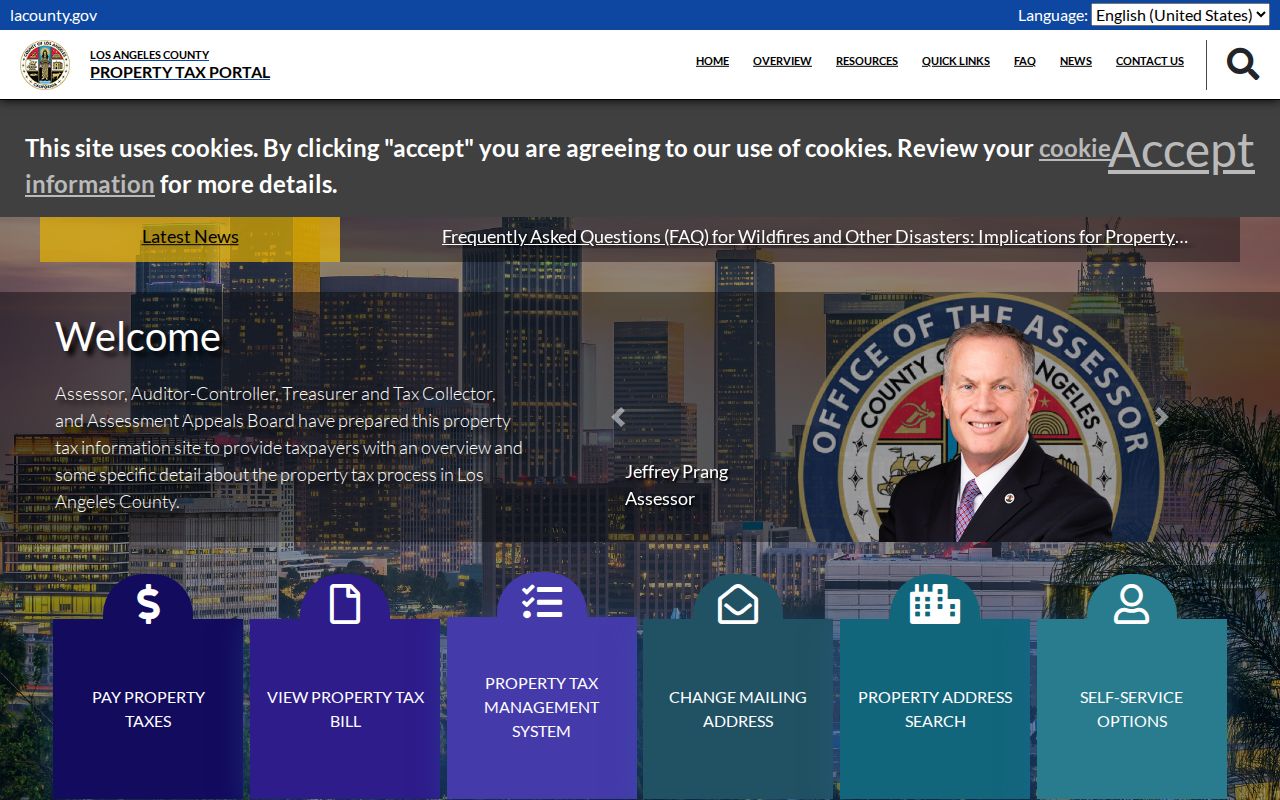
Tax information can corroborate an AIN and mailing route, but a tax bill still does not establish who occupies a unit.
Santa Monica Records Available by Street
Several record sets can be approached from an address, but they do not all describe the same relationship. This coverage table keeps the Santa Monica street directory grounded in what each source actually holds. The county recorder is included with a warning because it has no address search. The library reverse section is historical and selective. City permits describe work and project roles. Voter information is purpose-gated.
| Address Source | Street Capability | People Evidence | Caveat |
|---|---|---|---|
| Assessor portal | Address, AIN, parcel facts | Specific owner lead | Public owner display limited; mailing is not situs |
| Assessor map | Pan, click, and inspect adjacent polygons | AIN and parcel context | Not an occupant map |
| RR/CC recorder | No street search; name and year request | Grantor and grantee | Translate address to a name first |
| Santa Monica permits | Address, project, and permit history | Applicant, owner, or professional role | Role does not equal resident |
| SMPL reverse directory | House-number sequence in selected editions | Listed historical occupant or business | Coverage and listing habits vary |
| Purpose-qualified voter file | Residence field exists under state rules | Registered voter | No casual street browsing |
For a full named-street chain, the map and assessor search belong at the front. For a single person, switch to the name and case workflow. For an old occupant, use the historical collection rather than treating a current parcel result as a time machine.
Santa Monica Deeds Need a Name
Los Angeles County real-estate records reach back to 1850, but RR/CC does not publish a searchable online index. The index is organized by grantor, grantee, and recording year. A grantor transfers an interest. A grantee receives it. The county's FAQ explains that a street address alone cannot retrieve a deed, so the street directory workflow must first obtain a current-owner lead or another named party from the parcel record.
Once a name and approximate year are available, request the instrument by counter, mail, fax, or paid online copy order. A recorded result can identify the parties, document type, recording date, instrument number, and legal description. The image may include transfer-tax and return-mail information, with protected material redacted. The complete document is supplied rather than selected pages.
The county's no-index policy is linked to Government Code section 7928.205, formerly section 6254.21, which protects officials' home addresses from public web display. That reason explains why an address-first search is not an online recorder search. It does not make the deed series disappear. It changes the handoff from street to name and year.
Process: street address → AIN and legal description → specific owner lead → grantor/grantee name and year → recorded instrument → earlier party or later parcel.
Santa Monica Permits Mark Project Roles
Permit records are among the most useful city sources because they are keyed to an address. They can show a permit number, site, work description, applicant, contractor, architect, or owner role. The City of Santa Monica's current process is paperless through the Electronic Plan Review System at the Permit Services Center in City Hall East, 1685 Main Street. Older files may be held in archives or require a focused city request.
Permit evidence helps date construction, alteration, or a change in use. It does not establish that a named applicant lived at the site. Architectural plans, code-enforcement material, security details, personal contacts, and other protected records can be withheld or redacted. Ask first for the permit history or index, then request a narrower document when the access rule permits.
The Permit Services Center information shows the municipal entry point for address-keyed project records.
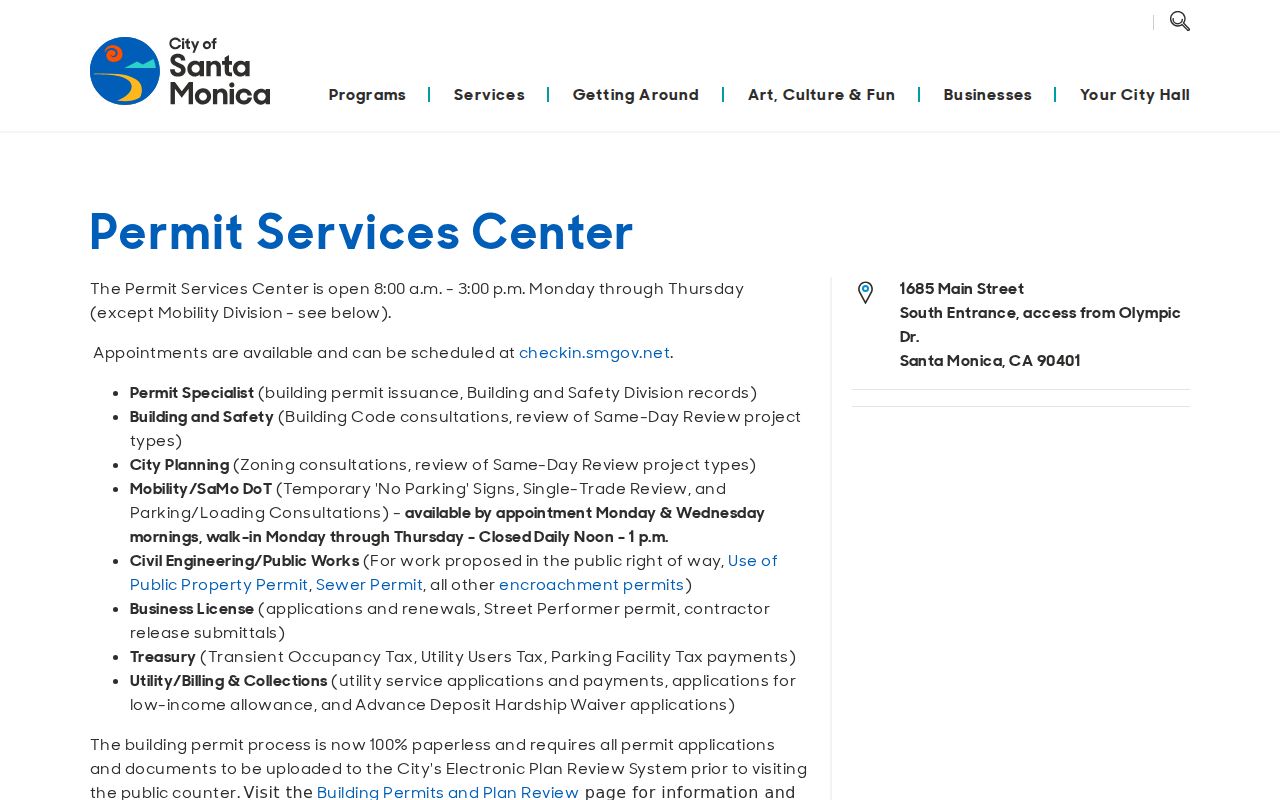
The city permit route adds building chronology to a street directory search while keeping a professional or applicant role separate from occupancy.
Read Santa Monica Streets in Reverse
Later volumes in the Santa Monica Public Library's Sharla P. Boehm Collection may include a reverse or criss-cross section arranged by street and house number. That is the historical part of the street directory: address in, listed occupant or business out. Browse the page image in house-number order and record vacant lots, “no return,” business entries, apartment distinctions, and abbreviations exactly as printed. OCR is often weakest in narrow columns, so a text hit should lead to visual inspection.
Scope changes across the collection. The 1907 Directory of the Santa Monica Bay District and the two 1912 editions cover overlapping communities, including Santa Monica, Ocean Park, Venice, and, in one edition, Sawtelle, Westgate, Brentwood Park, and Palms. An old street name or place label may therefore be inside a wider book than the modern city limit suggests. The complete year run and reading method belong to the Santa Monica directory book page.
A historical reverse entry is evidence of a listing at a particular time. It may omit an unlisted person, a short stay, or a unit. Pair it with a deed, census household, obituary, or permit only when the dates and address align.
90402 Crosses the Santa Monica Line
ZIP geography can mislead a street directory search. Los Angeles County's master ZIP table places 90402 across both the City of Santa Monica and Pacific Palisades, which is in the City of Los Angeles. A postal line that says Santa Monica is not a jurisdiction test. The parcel, assessor, permit, and city record custodian answer where a property legally sits.
The same caution applies to older directories. A Santa Monica Bay District title can include nearby communities that later have different city or ZIP identities. Preserve the original place label, then compare the tract, parcel map, street guide, and directory front matter. Do not silently convert an old community name into a modern boundary.
When an address is near the city edge, run both the USPS standardization and the county or city parcel check. A ZIP can guide delivery, while the AIN guides property records and the municipal boundary guides a records request.
Boundary check. 90402 is a documented overlap example. Verify the parcel's jurisdiction before requesting a Santa Monica permit or treating a postal address as a city resident record.
Santa Monica Condo AINs and Parcels
One parcel does not equal one household. A condominium may have separate unit AINs, while an apartment parcel can represent dozens of units. The assessor card can show unit count, lot size, use code, and physical characteristics, but those fields describe taxable property. A deed may transfer a unit or an underlying interest. A permit may identify a contractor or applicant. A directory may list only some adults or businesses.
- Parcel
- A mapped taxable interest identified by an AIN. It can contain one structure, several units, or multiple recorded interests.
- Situs address
- The physical location attached to the tax roll, distinct from a mailing destination.
- Plat
- A recorded map that helps explain lots, blocks, subdivisions, and legal descriptions.
- Criss-cross directory
- A reverse directory arranged by address, useful for historical listed occupants but not a complete household file.
Keep unit numbers, building names, and lot identifiers in separate fields. If a record shows only the parcel owner, do not assign that name to every unit. This distinction is one of the most important safeguards in a Santa Monica street directory search.
Voter Data on a Santa Monica Street
California's voter file can contain a residence field, but access is restricted to election, scholarly, journalistic, political, or governmental purposes under Elections Code section 2194 and 2 CCR sections 19000 through 19013. My Voter Status is an individualized identity match. It is not a street tool, and it cannot be used to compile a casual neighbor list.
Qualified file applicants must state the purpose, requested geography, file type, delivery, and security commitments. The state request inventory calls for full name, date of birth, county, residence address, and purpose for a specific-record request. Sensitive identifiers, signatures, and confidential Safe at Home registrations are withheld. Participation history describes whether and how a person voted, never ballot choices.
For street context, aggregate precinct products are safer than a household list. For an individual's own status, use the official identity route. A voter match should never be treated as proof of present physical presence because registration can lag a move and some people are protected from ordinary display.
What a Santa Monica Street Directory Omits
A street directory cannot reliably show every person connected to an address. It will miss people who are not listed in a historical volume, people whose records are protected, many household members, short-term occupants, and anyone whose connection is not part of the source's purpose. DMV addresses, utility customer lists, delivery records, and confidential voter details are restricted. A title owner may be a trust, LLC, estate, or absentee owner.
Use the smallest record set that answers the real question. For an estate, pair the deed chain with probate and obituary evidence. For a property-history question, use AIN, legal description, deeds, permits, and dated directories. For one named person, move to a name-based records workflow. Label every row by custodian and date so a 2026 map, a 1998 directory, and a 1950 census household are not presented as simultaneous facts.
Lawful use. Address research can support family history, estate work, civic records, and personal curiosity. Do not use a Santa Monica street directory to stalk, threaten, harass, or expose a protected person.
Note: The county recorder's name-and-year index and the assessor's parcel map answer different questions; keep both sources in the final citation.