
Sources Behind Previous Santa Monica Residents
A house-history search needs a time plan. Recorded real-estate instruments establish ownership interests from 1850 forward. The Santa Monica Public Library's Boehm directories show selected listed people and businesses from 1899 through 1998-99, with a 63-volume physical set and 46 editions visible online on August 16, 2026. Federal census schedules supply household snapshots through 1950. Permits date project work. Obituaries and probate can explain a death or estate transition. Each source covers a different slice of the previous residents question.
| Source | Years It Covers | Where Held | What It Shows |
|---|---|---|---|
| Recorded real estate | 1850-present | LA County RR/CC | Grantor, grantee, instrument, date, legal description |
| Digitized city directories | Selected 1899-1998/99 editions | SMPL Boehm Collection | Listed residents, businesses, addresses, occupations by edition |
| Physical directory shelf | 63 volumes, including undigitized years | Santa Monica Public Library | Reverse sections and gaps not visible online |
| Federal census | 1850-1950 public schedules; 1890 gap | NARA, partners, library databases | Household members and status on Census Day |
| Permits and planning | Varies by archive and project | Santa Monica departments | Construction chronology and project roles |
| Obituary and probate trail | Varies by person and repository | Newspapers, LASC, cemetery, library | Death, family, fiduciary, or estate clues |
The date column prevents a current record from being mistaken for a past resident. It also shows why an empty digital search is not proof that an older household never existed.
Santa Monica AIN Starts the House Trail
Normalize the address, check the county or city parcel map, and save the AIN, situs, legal description, tract, lot, and map date. The AIN is the durable property key when street text, ZIP labels, or unit descriptions shift. “Situs” is the physical tax-roll location. A mailing address is where tax material goes. Neither one identifies every person at the parcel.
Condominiums can have unit-level AINs. A larger apartment parcel can represent many units. A trust, LLC, estate, or absentee owner can appear in the title trail. Preserve unit numbers and legal descriptions so a later deed request does not attach one parcel owner to every past household.
The backward process is: address → AIN and legal description → specific current-owner lead → grantor or grantee name and year → deed → earlier party → dated occupancy evidence.
The present-day address handoff is explained in the Santa Monica street directory workflow, while the old volumes themselves belong to the historical collection.
Walk the Santa Monica Deed Chain
Los Angeles County's recorder series begins in 1850, but the public cannot browse its index online or search it by street address. RR/CC uses grantor, grantee, and recording year. A grantor transfers an interest; a grantee receives it. The current property lead therefore becomes a named-party request, and the seller on that deed becomes the next backward pivot.
- Verify the address and AIN, then request the current assessed owner for the specific parcel through the county's allowed process.
- Ask RR/CC for that owner as grantee near the known acquisition year, using the legal description or parcel facts to test the match.
- Read the resulting instrument for the grantor, grantee, recording date, document number, and legal description.
- Search the prior grantor as a grantee in an earlier year and repeat only when the legal description remains aligned.
- At each era, compare the address with a directory and census household so title and occupancy stay separate.
- Chain of title
- The sequence of recorded transfers that connects one ownership interest to an earlier one.
- Grantor
- The named party conveying an interest in the recorded instrument.
- Grantee
- The named party receiving the interest.
- Legal description
- The tract, lot, block, or other recorded land description used to identify the property beyond street text.
Do not chain on a shared name alone. A date, spouse, entity, legal description, instrument number, or adjacent record must support each pivot.
Request Santa Monica Past Owners
RR/CC accepts real-estate copy requests at a counter, by mail or fax, and through paid online ordering. The county states that ordinary processing can take up to twenty working days. A plain copy costs $5 for the first page and $3 for each additional page. A certified copy costs $6 for the first page and $3 for each additional page. A name-and-year search is $0.50 with a $1 minimum. The county supplies the complete recorded document rather than selected pages.
The Los Angeles County real-estate request route explains the channels and identifier needs.
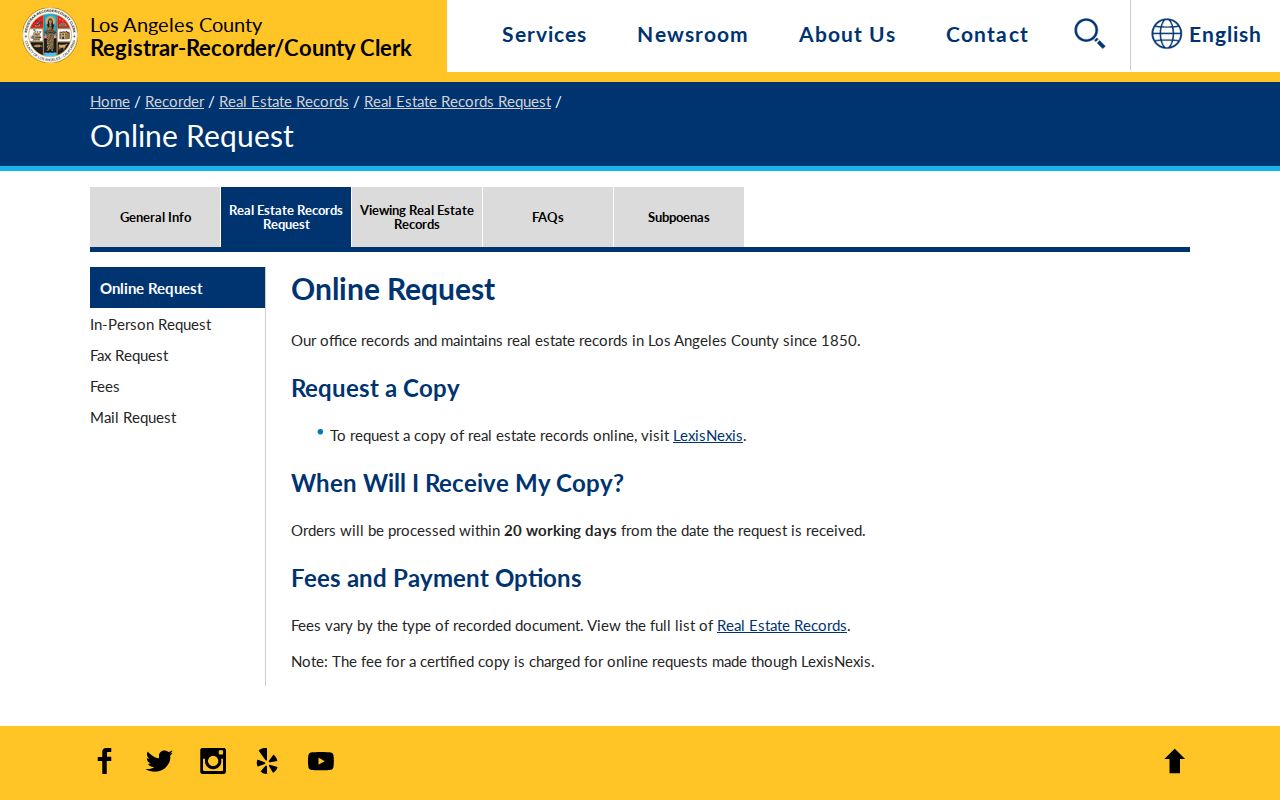
The request page reinforces the name-and-year handoff: an address must first become a named party and approximate recording date.
Use the county's published fees to compare a plain copy, certified copy, and search charge before ordering. A deed image can include transfer-tax and return-mail material, with sensitive content redacted under law.
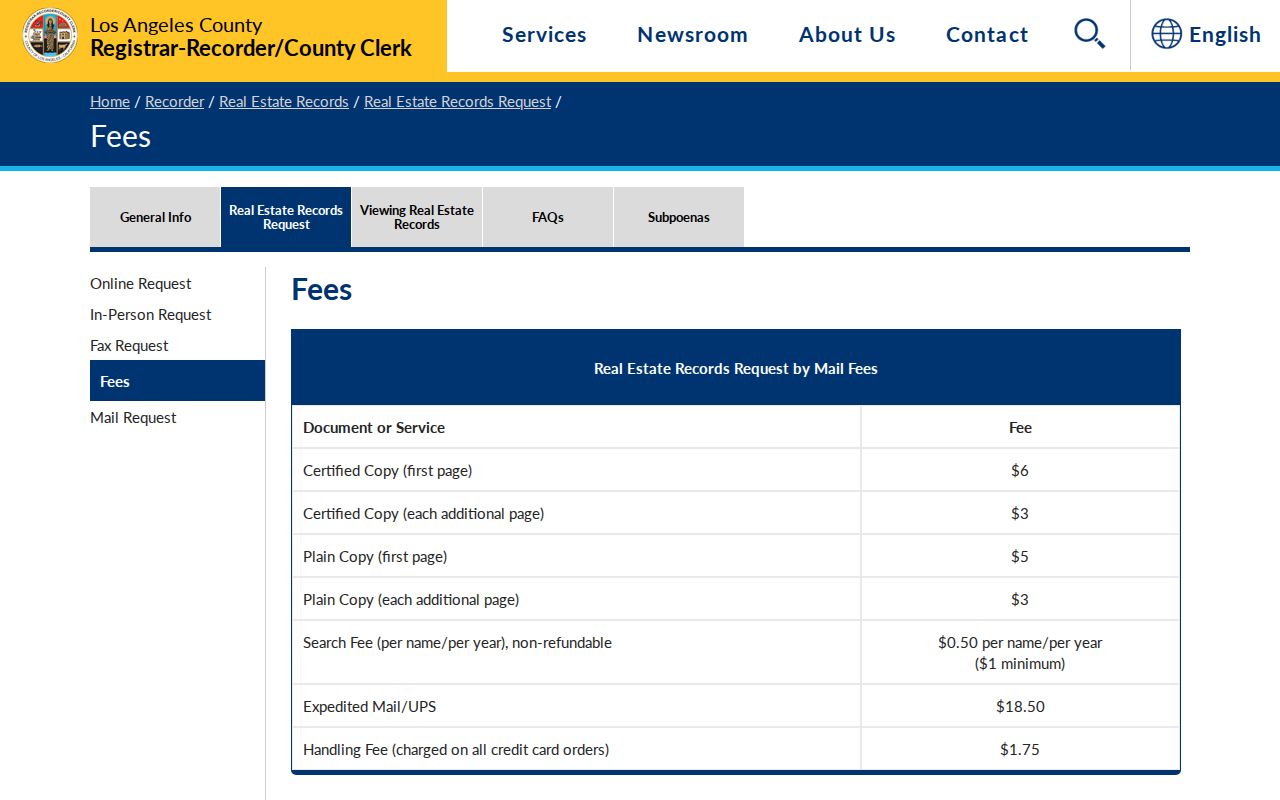
Keep the invoice, search parameters, and complete instrument together so a future owner pivot can be audited.
The recorder's real-estate records FAQs confirm the grantor, grantee, and year indexing method and the absence of address search.
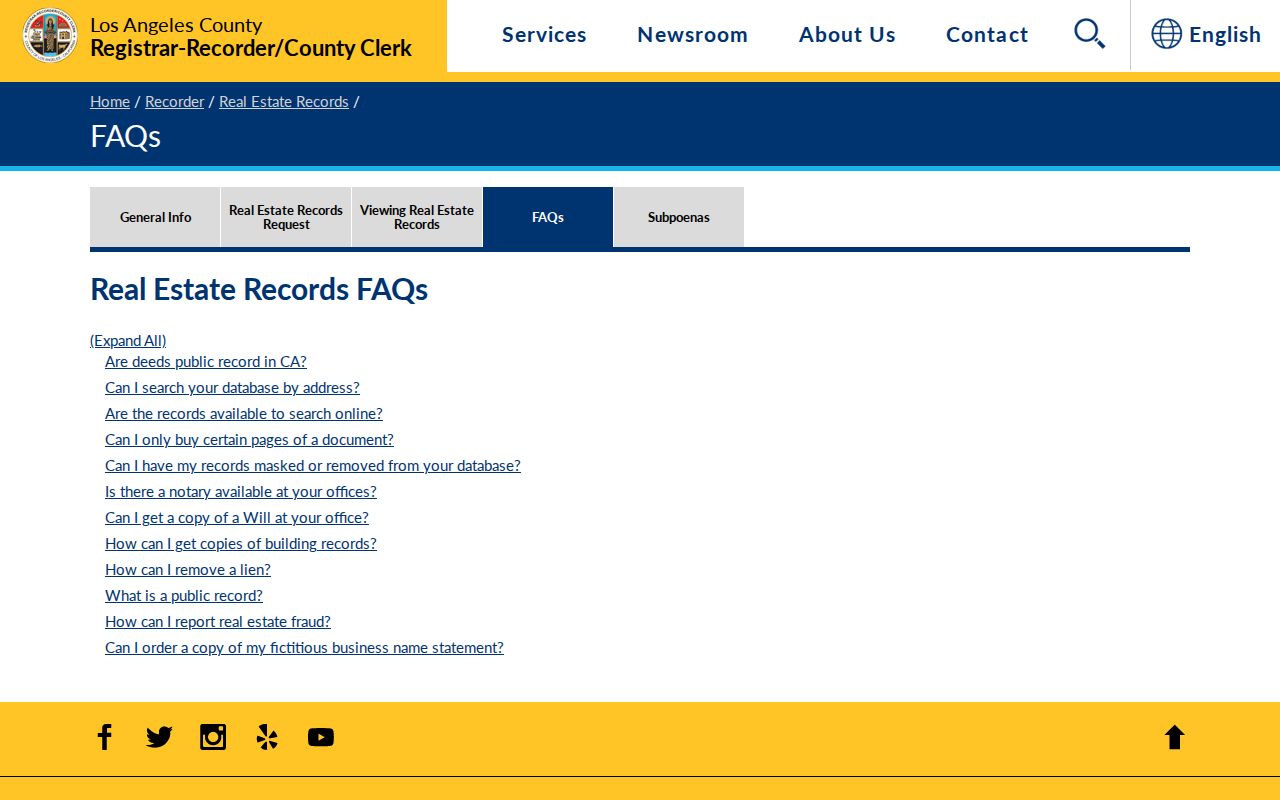
That limitation is why a parcel-to-owner lead must come before a backward deed request.
Note: The county's no-online-index rule protects officials' home addresses from open web posting; it does not remove the underlying record series.
Past Santa Monica Households Through Time
City directories can show a listed occupant, spouse notation, occupation, business, or address in an edition year. Census schedules show a household on Census Day. Neither is a continuous roll. The Boehm digital catalog has selected editions from 1899 through 1998-99, while the physical set holds 63 volumes. The newest released federal decennial census is 1950 in 2026 because schedules become public after the 72-year rule.
For a known address, open the directory page image, record the entry exactly, then compare the closest census year. Search both the alphabetical name section and any later reverse section. A directory entry can show a boarder, business, or only one listed adult. A census household can record people who never appeared in a city directory. Use the two sources as complementary snapshots.
- Choose the closest directory edition before or after the deed transfer.
- Check the street sequence and address form, including old community names.
- Compare the matching census year and note household members, relationship, and status on Census Day.
- Repeat with an adjacent directory edition to bound arrival or departure rather than inventing an exact move date.
The SMPL directory collection is free to browse, but OCR and download rights vary by item. The 1890 population schedule is largely lost nationally, so local directories, deeds, newspapers, and probate often carry that gap.
Santa Monica Address Names Change Over Time
Older Santa Monica directories can use place labels that do not match a present-day ZIP or city boundary. The 1907 book is titled Directory of the Santa Monica Bay District. Two separate 1912 editions cover Santa Monica, Ocean Park, Venice, and, in one edition, Sawtelle, Westgate, Brentwood Park, and Palms. Ocean Park's separate historic identity can make a family appear to move between headings when the physical distance was small.
Changed street names, numbering, subdivisions, demolished structures, and rebuilt parcels create similar breaks. No single official chronology of every Santa Monica street change was located in the research. Resolve a particular address by comparing directory street guides, parcel maps, tract or lot descriptions, council or PublicDocs material, and Sanborn map context. Keep the old wording in quotation marks in research notes.
The county ZIP table's 90402 overlap adds a modern version of the same problem. A postal line and an old directory title are both useful clues, but neither replaces the parcel and legal description.
Santa Monica Permits Date the Building
Santa Monica permit and planning records can anchor a physical change at the parcel. A permit number, work description, applicant, architect, contractor, and approval date can explain why an address looks different across two directory years. The current Electronic Plan Review System is paperless through the Permit Services Center at City Hall East. Older files may need a request or department inspection.
Project roles are not evidence that a person lived at the address. Full architectural plans may involve copyright, security, or authorization limits. Ask for the permit history or index first. Then compare the construction date with the directory, deed, census, and newspaper timeline. A building change can narrow the date of a move without naming every person involved.
Sanborn fire-insurance maps can add footprint, material, and use context, but they do not name occupants. The Library of Congress collection and local library material are historical aids, not substitutes for a recorded deed or civil certificate.
Santa Monica Probate Closes the Trail
When a former occupant has died, probate and obituary evidence can explain a change that a deed alone cannot. A probate index or file may name a decedent, petitioner, fiduciary, heirs, and case events. An obituary can connect a person to family, neighborhood, organization, or a former address. The Superior Court file, not a newspaper notice, controls the court fact. A death certificate or informational copy remains a separate vital-record route.
For a known Los Angeles County marriage, the RR/CC marriage inspection path requires a specific record, appointment, sufficient identifiers, and identification. It can help connect names across a household timeline while respecting confidentiality rules.
A county marriage record can support a family-history link, but it does not by itself prove that a spouse lived at the researched parcel on the date of the ceremony.
Pair the ending evidence with the last directory, deed, census, or permit that places the person in Santa Monica. If the trail reaches an estate, read the register and judgment rather than assuming that a name in an obituary received title.
Santa Monica Record Gaps
A gap can mean an undigitized directory, an unindexed recorder step, a destroyed or sealed file, a changed address, or a source that never listed the person. The SMPL shelf is larger than the online catalog. FamilySearch can help locate Los Angeles County deeds, vital registers, and probate materials by place hierarchy, although image access may require an account, center, or affiliate library. NARA Riverside serves Southern California federal records. Newspapers, cemetery ledgers, church registers, photographs, and oral histories can supply context.
Label a gap rather than smoothing it over. Write “not found in the searched edition” or “county search did not identify a record under this name and year,” not “the person was absent.” A certificate of no record reports the custodian's search parameters; it does not prove the event never happened. This discipline keeps previous residents research honest.
The library's Mexican Presence collection and other oral-history material can restore family stories that property files flatten. Community memory is valuable evidence, but its access rules and date should remain visible beside formal records.
Santa Monica Previous Residents: Limits
Past-resident research can reconstruct a documented sequence, but it cannot prove every person who stayed at an address or the exact day someone arrived. A deed establishes a recorded transfer. A directory establishes a listing. A census establishes a household snapshot. A permit establishes a project role. An obituary establishes a published death notice. None is a complete occupancy register.
Keep current ownership separate from previous residents, and keep a historic listing separate from present physical presence. Protected addresses, sealed adoption and court material, DMV information, utility records, and private membership lists may never be available. Correct an error with the agency that created the source. Do not try to infer a missing person from a neighbor, ZIP, or shared surname.
House-history limit. Use a Santa Monica address trail for family history, estate research, preservation, and personal curiosity. Do not use records about previous residents to stalk, threaten, or harass anyone.
Note: A past occupant may never have held title, and a title holder may never have occupied the parcel; the two trails must be cited separately.