
Santa Monica City Directory Shelves
Santa Monica Public Library’s Sharla P. Boehm Collection is the central local source. The library describes 63 physical volumes, while its live catalog showed 46 named digitized editions on August 16, 2026. Those counts answer different questions: the shelf is broader than the viewer, and the viewer is a catalog snapshot. Titles and publishers vary, so a missing online year is not proof that no book was printed.
| Collection | Years | Where Held | Access |
|---|---|---|---|
| Sharla P. Boehm physical set | 1899-1998/99 | Santa Monica Public Library local history and reference staff | 63 volumes; ask for undigitized years and reverse sections |
| Digitized Boehm editions | 1899-1998/99; 46 observed in 2026 | SMPL ContentDM Directories collection | Free viewer; some downloads have use limits |
| Bay District directory items | 1907 and two 1912 editions | SMPL digital collection | Free compound-object page viewer |
| Federal census companions | 1850-1950 public schedules | NARA Riverside, partners, and libraries | Decennial evidence; 1950 is newest released in 2026 |
The physical collection remains important because the online list is not the full shelf. Ask library staff about undigitized years, front matter, and the reverse or criss-cross arrangement. A directory is a dated listing, not a complete resident roll.
The SMPL digitized directory collection is the best first stop for page images and catalog metadata.
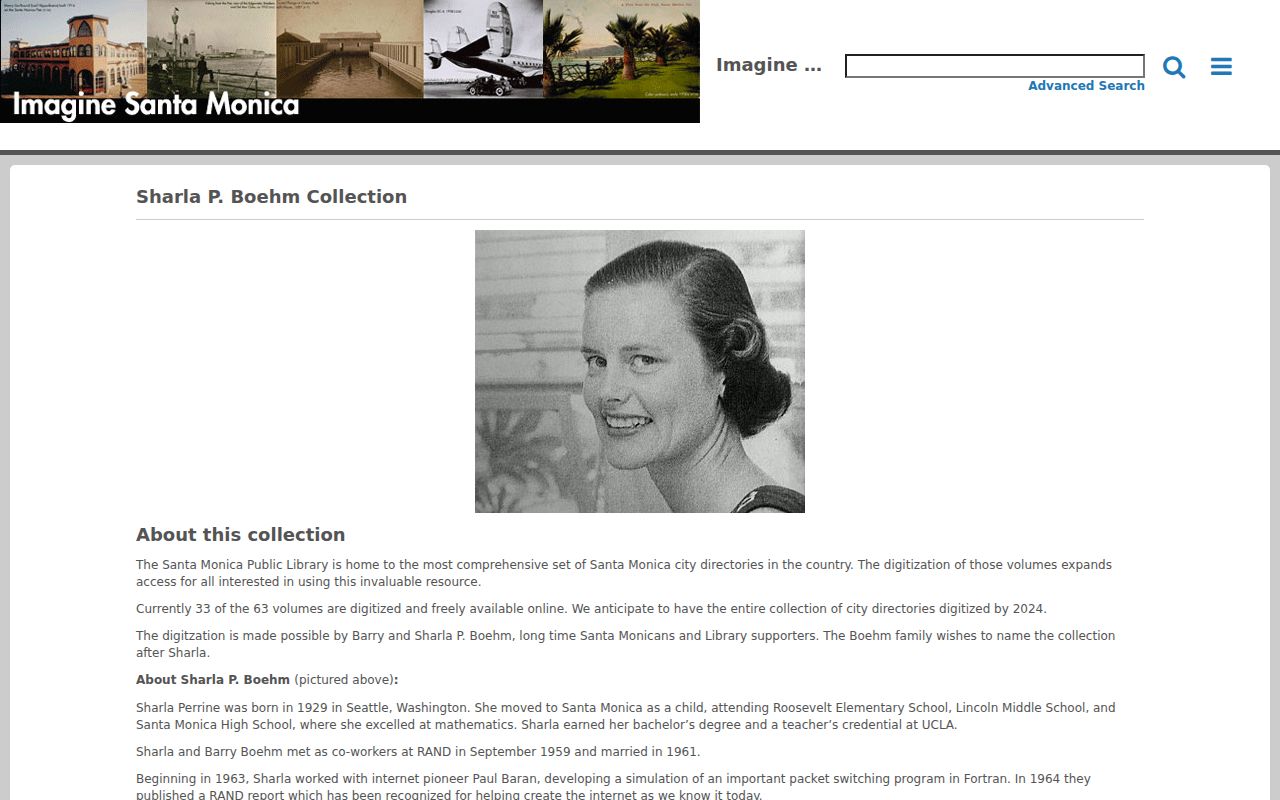
The collection viewer can bridge a name search to a scanned page, but a shelf request is still needed when the desired year is absent online.
46 Santa Monica Directory Editions Online
The live catalog inspection on August 16, 2026 showed 46 named editions. The run is useful, but it is not a complete annual sequence. Several years are paired, and gaps require the physical set or another repository.
- 1899-1929: 1899, 1905, 1907, two 1912 books, 1913-14, 1915-16, 1917, 1918, 1919-20, 1921-22, 1923-24, 1925, 1927, and 1928.
- 1930-1959: 1930-31, 1933, 1936, 1938, 1940, 1947-48, 1952-53, and 1954.
- 1960-1979: 1960-61, 1975-76, 1976-77, 1977-78, and 1979-80.
- 1980-1998: annual or biennial issues from 1980-81 through 1992-93, then 1994, 1995, 1996, 1997, and 1998-99.
The older collection description referred to 33 digitized volumes, but the live catalog showed 46 editions at the dated inspection. Use the inspection date when citing the count. Some download controls are marked for in-library use, so page viewing and downloading are not always the same access route. Later annual or biennial volumes can support address work, but the edition itself decides whether a reverse section is present.
Two 1912 Santa Monica Directory Scopes
Early titles do not obey modern city or ZIP boundaries. The 1907 volume is titled Directory of the Santa Monica Bay District. Two separate 1912 editions cover Santa Monica, Ocean Park, and Venice; one also names Sawtelle, Westgate, Brentwood Park, and Palms. A family can therefore appear under a community heading that later feels like a different city.
The 1907 Santa Monica Bay District directory viewer shows how a compound item divides a historic book into searchable parts.
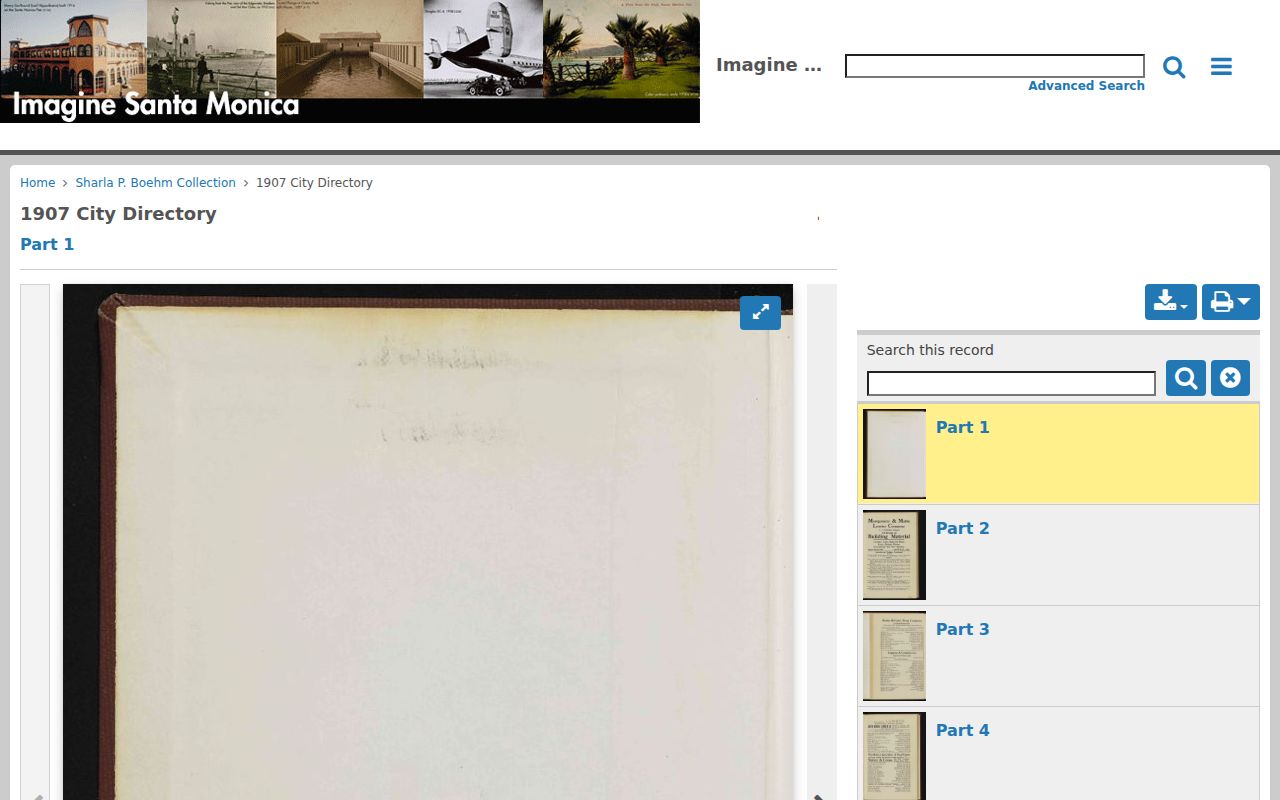
Read the title, description, and front matter before assigning an entry to today’s city. When a historic place name causes confusion, the Santa Monica ZIP code directory can help separate postal geography from older directory geography.
Decode a Santa Monica City Directory Entry
A typical Santa Monica city directory entry is compact. It may combine a surname, given name or initial, spouse notation, occupation or business, and a residence or business address. The exact columns change by year, and advertisements or abbreviations make the front matter part of the record.
- Name: surname first, followed by a given name or initial; compare variants before merging identities.
- Family note: a spouse notation or widow notation can connect two entries, but it is not present in every run.
- Work or business: an occupation and business address show a public role, not necessarily a home address.
- Residence: a house number and street may identify where the person was listed in that edition.
- Owner, renter, or board mark: symbols vary by volume; use the book’s own key rather than assuming a mark.
- Ads and abbreviations: front matter may explain shortened streets, occupations, businesses, and directory symbols.
- Criss-cross directory
- A later address-order section that lets a researcher browse a street or house number instead of starting with a surname.
- Householder index
- A name or address reference centered on listed householders when a volume includes one; it is not a promise of every occupant.
- Abbreviation key
- The volume’s explanation of short forms and symbols, usually found before the listings or near the advertisements.
- OCR
- Machine-read text made from a scan. Small type and columns can be misread, so the printed page should settle a doubtful name.
Search the Santa Monica Directory Viewer
SMPL’s digital collection offers several ways into a compound directory. Search a collection when the year or title is unknown. Search a record when the correct book is open. Then use page navigation and the image itself to confirm the OCR.
The SMPL local-history collections place directories beside newspapers, photographs, oral histories, and other Santa Monica material.
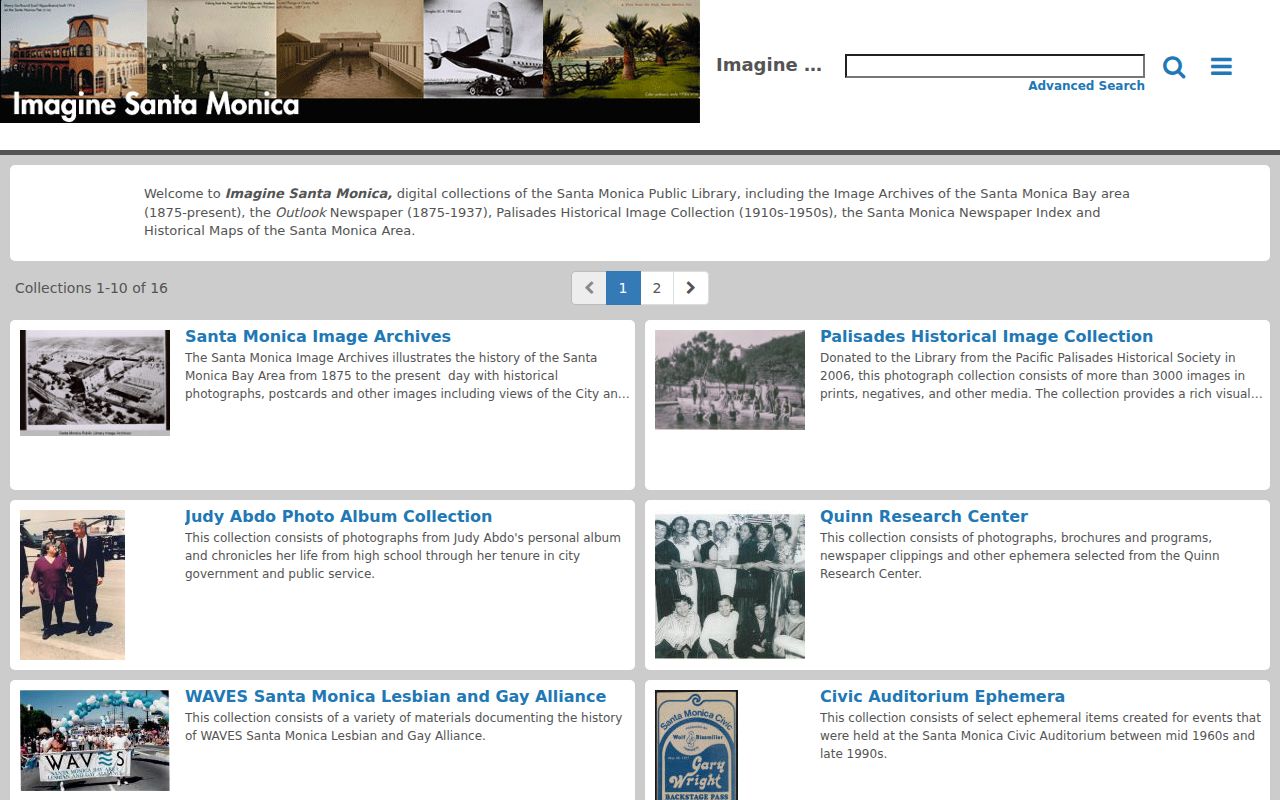
The broader collection is useful when a directory name leads to a photograph, newspaper item, or community memory record.
| Search this collection | Keyword search across available catalog text and collection items. |
|---|---|
| Title, Date, Subject | Metadata facets for narrowing a mixed collection to a directory or year. |
| Search this record | Searches within the open compound item and its page OCR when available. |
| Page navigation | Previous, next, and page controls move through the scanned parts of a book. |
| Download | Item control subject to rights, use, and in-library restrictions. |
OCR is a finding aid, not a final transcription. Browse the printed column, capture the page number or part, and retain the title and date so a later researcher can reproduce the path.
Trace a Santa Monica Household Through Directories
For family history, begin with the strongest known name, address, or year. The goal is to build a dated sequence, not to force every appearance into one household. The FamilySearch catalog can add Los Angeles County deeds, vital registers, probate, or census pathways; place searches should use United States, California, Los Angeles and Santa Monica.
FamilySearch access can require a free account, a FamilySearch Center, or an affiliate library for some images.
- Find the name or address in the closest available directory year, then copy the entry exactly.
- Repeat in adjacent editions and note each address, spouse notation, occupation, and unexplained gap.
- Use a reverse or criss-cross section when the question begins with a street rather than a surname.
- Pair directory evidence with the released 1900, 1910, 1920, 1930, 1940, or 1950 federal census.
- Close a deceased person’s timeline with newspapers, an obituary, cemetery evidence, probate, or a vital record.
A disappearance can mean a move, death, an unlisted household, a skipped publication year, or an OCR miss. Dates, addresses, relatives, and record numbers help distinguish those possibilities.
Santa Monica City Directory Timeline
Directory history sits inside a wider records timeline. Santa Monica’s local evidence shifts from county and regional sources to printed books, then to scans and searchable catalog records.
- 1850: Los Angeles County real-estate records begin, supplying a deed companion rather than a resident list.
- 1886: Santa Monica incorporates; earlier evidence may sit in county, federal, rancho, land, or regional sources.
- 1899: the Boehm directory chronology begins online, followed by 1905 and 1907.
- 1912: two Bay District editions expose overlapping communities and shifting directory geography.
- 1950: the newest federal census schedule released in 2026 under the 72-year rule.
- 1998-99: the latest edition visible in the observed digital run, with physical gaps still possible.
The NARA Riverside regional records service is a useful federal companion for Southern California census and archival research.
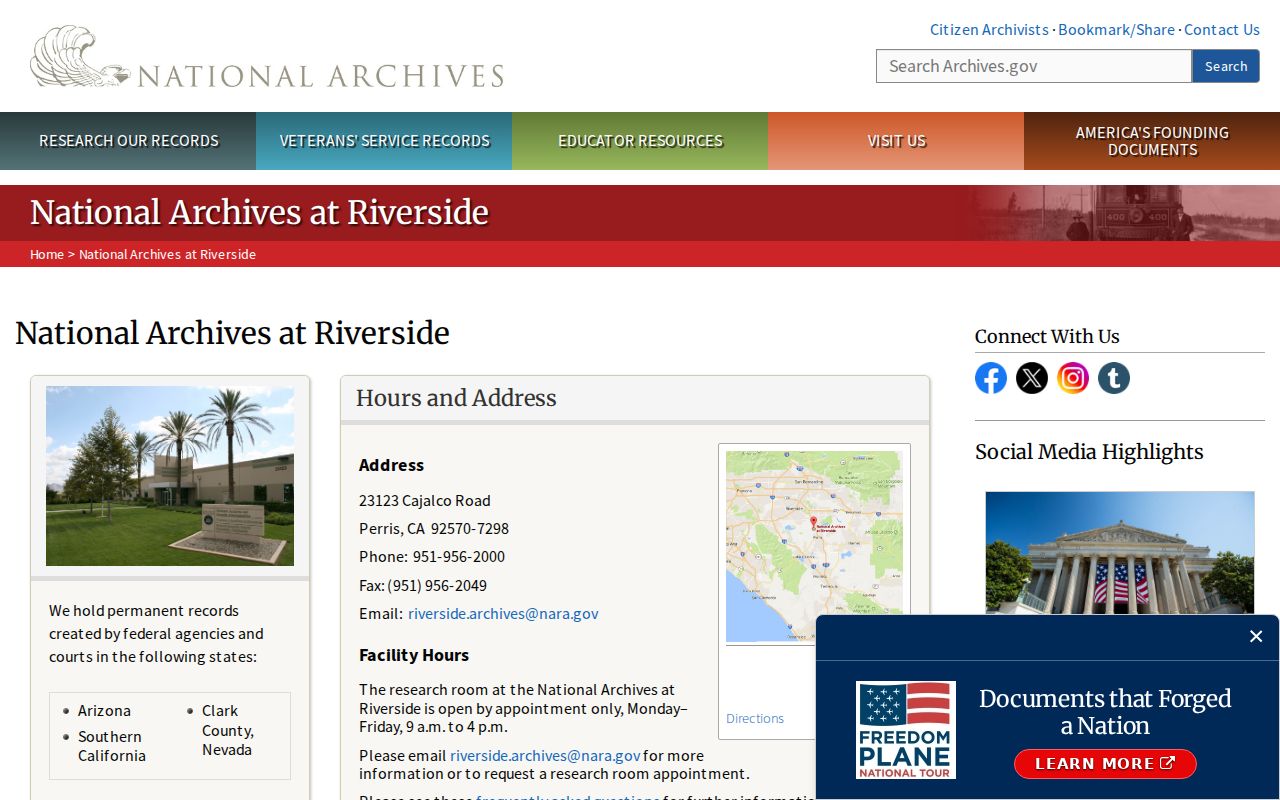
Federal schedules and local directories do not describe the same date, so label each source by its year and record type.
Fill Gaps Around Santa Monica Directories
SMPL’s local-history material can restore context that a directory flattens. Newspapers and photographs may place a person at a storefront or civic event. Imagine Santa Monica oral histories and the Mexican Presence in Santa Monica project preserve family stories, interviews, and scanned photographs that formal rolls may omit.
The Santa Monica Public Library digital collections are the starting point for those companion sources.
Pair a directory line with a local newspaper issue, an obituary, Woodlawn Cemetery research, probate, or a community archive when a family timeline reaches an endpoint.
Exact licensed database titles and an official obituary-index year run were not located in the available research. Library staff should confirm current subscriptions and index coverage before a search is described as complete. Newspapers, obituaries, cemetery entries, and probate serve different roles, so each should retain its date and custodian.
Older evidence is mixed by design. A deed names parties, a census captures a household on one date, and a directory reflects selected listings. Keep those roles distinct when a gap spans several years.
Santa Monica Directory Records and Current Detail
A historical directory records what a publisher listed at a particular time. It does not show every renter, household member, guest, vacant lot, or present occupant. Later reverse sections help with an address-to-name question, but they remain incomplete and can include businesses or a single listed adult.
Research boundary. A city directory is a dated historical source, not a complete contemporary roster or proof of present occupancy.
Modern address work needs a parcel, AIN, legal description, and current custodian rather than a directory assumption. A dated listing can supply a lead, while the Santa Monica street directory workflow handles present address-keyed records. Keep the historical book and the modern parcel trail separate.